
What is Sales Funnel and why it matters in 2026?
Every stalled revenue target hides a weak point somewhere inside the sales funnel.
What Is a Sales Funnel?
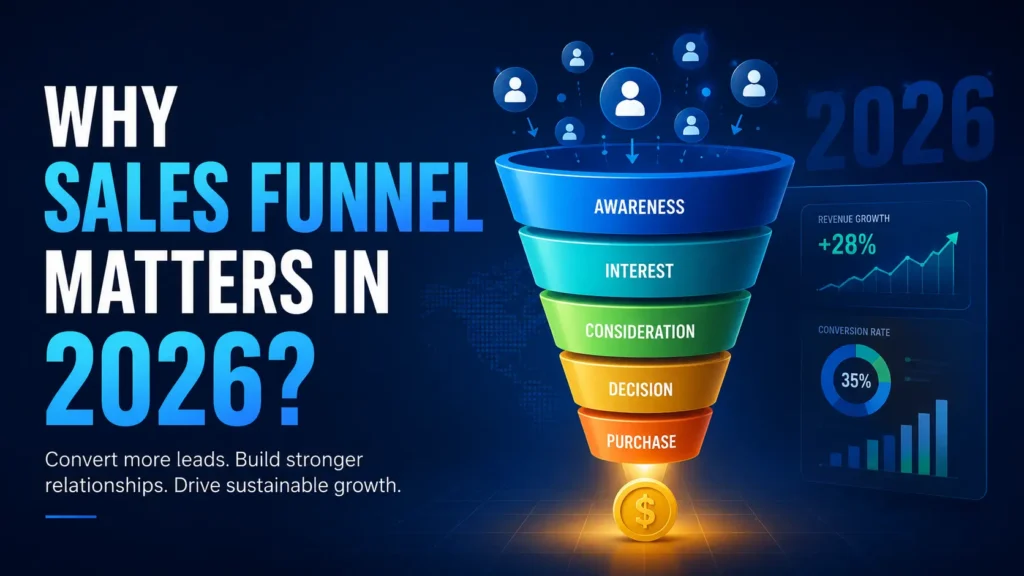
A sales funnel describes the journey a customer takes from discovering a business to becoming a paying client. It helps companies understand how prospects move through different buying stages and where they lose attention, interest, or trust.
Most businesses divide the sales funnel into several core stages:
- Awareness
- Interest
- Consideration
- Decision
- Retention
At the awareness stage, customers first discover a product through channels like search engines, social media, referrals, webinars, paid ads, or content marketing.
At the interest stage, potential buyers begin researching the company, comparing features, reading reviews, or exploring educational content.
During consideration, buyers evaluate whether the solution fits their specific needs. They may request demos, compare pricing, or speak with sales representatives.
The decision stage focuses on conversion. Customers finalize contracts, complete purchases, or subscribe to services.
The modern sales funnel does not end after the purchase. Retention and expansion now play a major role in long-term growth. Companies that keep customers engaged often generate more revenue through renewals, upgrades, and referrals.
A strong sales funnel gives businesses visibility into customer behavior. Instead of guessing why growth slows down, companies can identify exactly where prospects drop off.
For example, a SaaS company may discover that thousands of users visit its website every month, but very few request a demo. That problem points to weak messaging or poor positioning near the top of the sales funnel.
Another company may attract qualified leads but struggle to close deals. In that case, pricing complexity, onboarding friction, or trust issues may damage the lower stages of the sales funnel.
Without a clear sales funnel, businesses often waste marketing budgets, overload sales teams, and chase low-quality leads.
Why the Sales Funnel Matters More in 2026
The importance of the sales funnel continues to grow because buying behavior has changed dramatically.
Customers now complete most of their research before speaking with a sales team. Buyers compare competitors, study online reviews, explore technical documentation, and evaluate pricing independently.
That shift forces businesses to build smarter and more efficient sales funnels.
AI Has Changed Customer Expectations
Artificial intelligence has transformed digital marketing and outbound sales.
Customers receive endless cold emails, automated messages, and AI-generated advertisements every day. Generic outreach no longer works.
A well-designed sales funnel helps companies stand out through relevance and personalization.
Businesses now use AI tools to:
- score leads
- personalize email campaigns
- automate follow-ups
- analyze customer intent
- predict conversion behavior
- optimize pricing strategies
However, automation alone does not create trust.
Companies that succeed in 2026 combine automation with authentic communication, valuable content, and fast customer support.
Competition Has Increased
Digital markets have become more crowded across nearly every industry.
Customers can compare products instantly. Switching costs continue to decline in many software and service categories.
A strong sales funnel helps businesses compete more effectively by improving customer experience at every stage.
Companies with weak funnels often lose buyers before sales conversations even begin.
Revenue Efficiency Matters More
Investors and executives now focus heavily on efficient growth.
Businesses can no longer rely only on aggressive advertising or large sales teams.
The sales funnel directly impacts:
- conversion rates
- revenue growth
- customer retention
- lifetime value
- profitability
Small improvements inside the sales funnel can produce major financial gains.
For example, improving a conversion rate from 2% to 4% can double revenue without increasing traffic.
That leverage makes funnel optimization one of the most important growth priorities in 2026.
Key Elements of a High-Performing Sales Funnel
Successful businesses treat the sales funnel as a system rather than a one-time marketing campaign.
The best funnels focus on four major areas.
1. Targeted Traffic Acquisition
The top of the sales funnel should attract the right audience instead of the largest audience.
High-quality traffic sources include:
- search engine optimization
- educational content
- webinars
- industry newsletters
- referral programs
- social proof
- strategic partnerships
Companies that attract unqualified traffic often waste time and budget.
A cybersecurity company targeting enterprise clients should focus on decision-makers, not random internet traffic.
The sales funnel works best when businesses align marketing efforts with customer intent.
2. Clear Messaging and Positioning
Customers should quickly understand:
- what the company offers
- who the product serves
- why it matters
- how it solves problems
Confusing messaging weakens conversion rates.
Strong positioning improves trust and reduces friction throughout the sales funnel.
The best companies communicate value clearly within seconds.
3. Smooth Evaluation and Onboarding
Modern customers expect fast and simple buying experiences.
A complicated evaluation process can destroy momentum.
Businesses should simplify:
- product demos
- onboarding flows
- account setup
- pricing transparency
- customer support
- implementation guidance
Many successful software companies grow rapidly because customers can test products quickly without unnecessary barriers.
Fast onboarding strengthens the sales funnel by helping buyers experience value earlier.
4. Retention and Expansion
Customer retention now matters as much as customer acquisition.
The strongest businesses continue investing in the sales funnel after conversion.
Post-sale funnel strategies include:
- customer education
- product usage tracking
- renewal campaigns
- loyalty programs
- upselling opportunities
- proactive support
Retention increases profitability because keeping existing customers usually costs less than acquiring new ones.
Companies with strong retention also benefit from referrals, reviews, and organic brand growth.
Common Sales Funnel Mistakes Businesses Must Avoid
Many companies struggle with the sales funnel because they focus on activity instead of outcomes.
Several common mistakes continue to slow growth.
Focusing on Vanity Metrics
Website traffic, likes, impressions, and follower counts do not guarantee revenue.
Businesses should prioritize metrics tied directly to conversion and retention.
A smaller audience with strong buying intent often produces better results than massive low-quality traffic.
Ignoring Customer Data
Modern sales funnels depend heavily on analytics and behavioral insights.
Companies should track:
- bounce rates
- demo requests
- customer engagement
- onboarding completion
- purchase behavior
- churn patterns
Data helps businesses identify bottlenecks and improve funnel performance.
Overcomplicating the Funnel
Some businesses create too many stages, excessive automation, or confusing workflows.
Complexity slows decision-making and frustrates customers.
The best sales funnels remain simple, measurable, and easy to optimize.
Neglecting Mobile Experience
Mobile traffic continues to dominate many industries.
A poor mobile experience can severely damage conversion rates.
Businesses should ensure websites, forms, demos, and onboarding systems work smoothly across all devices.
Forgetting Human Trust
Automation improves efficiency, but buyers still value authentic communication.
Customers want fast answers, clear guidance, and real expertise.
Businesses that balance automation with human interaction usually build stronger customer relationships.
The sales funnel has evolved from a simple marketing framework into a critical business growth system.
In 2026, companies that optimize the sales funnel will improve conversion rates, strengthen customer trust, reduce acquisition costs, and scale revenue more efficiently.
The businesses that win over the next decade will not simply attract attention. They will guide customers through a sales funnel that delivers value at every stage.
FAQs
What is the main purpose of a sales funnel?
The main purpose of a sales funnel is to guide potential customers through the buying journey. It helps businesses attract leads, build trust, improve conversions, and increase customer retention.
Why does a sales funnel matter in 2026?
A sales funnel matters more in 2026 because customer behavior has changed. Buyers now research products independently, compare competitors online, and expect personalized experiences before making purchasing decisions.
What are the stages of a sales funnel?
Most sales funnels include awareness, interest, consideration, decision, and retention. Each stage focuses on moving customers closer to conversion while building trust and engagement.
How can businesses improve their sales funnel?
Businesses can improve the sales funnel by targeting qualified audiences, simplifying onboarding, using customer data effectively, improving messaging, and reducing friction during the buying process.
What tools help manage a sales funnel?
Popular tools for managing a sales funnel include CRM platforms, analytics software, email automation systems, customer support tools, and AI-powered lead scoring platforms.
What is the difference between a sales funnel and a marketing funnel?
A marketing funnel focuses on attracting and nurturing leads, while a sales funnel focuses on converting leads into paying customers. Many modern businesses integrate both into one growth system.
written by : SAN MARKETING