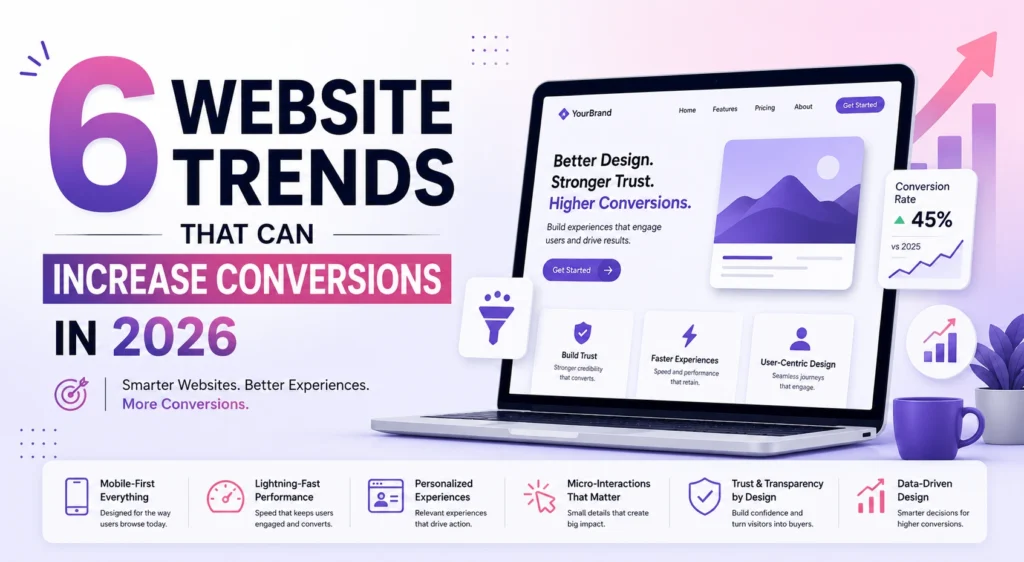
6 Website Trends That Can Increase Conversions in 2026
6 Website Trends That Can Increase Conversions in 2026 A website is no longer just a digital storefront. In 2026, it needs to work like a 24/7 salesperson—helping visitors find information, answering objections, building trust, and making the next step obvious. Businesses that focus only on attractive visuals can easily miss the factors that actually influence conversions. From AI-powered personalization to faster mobile experiences, the most effective website trends in 2026 focus on reducing friction and making every interaction more relevant. Here are six trends worth prioritizing if your goal is to turn more website visitors into customers. 1. AI-Powered Personalization One of the biggest website trends that can increase conversions in 2026 is AI-powered personalization. Instead of presenting exactly the same website experience to every visitor, businesses can use behavioral signals and customer data to make content, recommendations, and offers more relevant. For example, an ecommerce website can recommend products based on browsing behavior, previous purchases, or categories a visitor has explored. A SaaS website can highlight features relevant to a visitor’s industry or company size. Even a content website can adjust recommendations based on the topics someone has already read. The key is to use personalization to reduce decision-making effort. Visitors should feel that the website understands what they need rather than feeling as though the company is tracking every action they take. Personalized CTAs can also help. A first-time visitor might see “Learn More,” while someone who has already explored pricing could see “Start Your Free Trial.” Matching the message to the visitor’s intent creates a more natural conversion path. 2. Faster and More Efficient Website Experiences Website speed continues to play an important role in user experience and conversions. Nobody wants to wait for a large hero image, unnecessary animation, or complex script to load before they can understand what a business offers. In 2026, businesses are increasingly focusing on leaner websites that prioritize performance over unnecessary visual effects. Optimized images, efficient code, caching, modern hosting infrastructure, and fewer third-party scripts can all contribute to a smoother experience. Performance also matters because visitors use websites across a wide range of devices and network conditions. A page that feels fast on a high-end desktop with a strong connection may perform very differently on a smartphone using mobile data. Businesses should therefore monitor real-user performance rather than relying exclusively on ideal laboratory conditions. Google’s Core Web Vitals provide useful metrics for evaluating loading performance, responsiveness, and visual stability. A faster website does more than improve technical scores. It removes a barrier between the visitor and the action you want them to take. 3. Mobile-First Conversion Design Mobile-first design has moved beyond simply making desktop websites responsive. In 2026, businesses need to design conversion journeys specifically around how people interact with smartphones. Think about a typical mobile visitor. They may be using one hand, dealing with a small screen, switching between apps, or browsing while away from their desk. If your website requires excessive typing, tiny buttons, complicated menus, or repeated scrolling, the experience quickly becomes frustrating. A strong mobile conversion experience should include large, easy-to-tap buttons, readable text, simple navigation, short forms, optimized images, and clearly visible calls to action. Checkout deserves special attention. Customers should not have to complete a long sequence of unnecessary fields simply because the desktop version of the website was designed that way. Mobile-first design also means prioritizing the information users actually need. Instead of forcing visitors through several screens to discover pricing, delivery details, product specifications, or contact information, bring important information closer to the decision point. The goal isn’t simply to make the desktop website fit a smaller screen. It is to create an experience that feels naturally designed for mobile users. 4. AI Search and Conversational Website Experiences Search behavior is changing as people increasingly use AI tools to research products, services, and solutions. This creates a new opportunity for businesses to make their websites easier for both users and AI systems to understand. Traditional website search often expects visitors to enter exact keywords. Conversational search takes a different approach. A customer might type, “What laptop is best for video editing under ₹1 lakh?” or “Which plan should I choose for a team of 20?” Websites can respond to this behavior with smarter internal search, conversational interfaces, recommendation tools, and detailed product information. This trend also makes high-quality website content more important. Product pages and service pages should clearly explain features, benefits, pricing, specifications, use cases, limitations, FAQs, and comparisons. When a visitor arrives after researching through an AI platform, they may already have strong purchase intent. Your website needs to give them enough information to validate their decision rather than making them search elsewhere. The best approach isn’t to add an AI chatbot simply because AI is popular. Ask what customers struggle to find and use AI where it can genuinely remove that friction. 5. Interactive Product and Service Experiences Static pages can explain an offer, but interactive experiences can help visitors understand it. That is why interactive product demonstrations, calculators, configurators, comparison tools, virtual try-ons, quizzes, and interactive visuals are becoming valuable website trends for increasing conversions. Consider a financial services company. Instead of explaining potential savings in a paragraph, it could offer a calculator that estimates savings based on the visitor’s inputs. A software company could provide an interactive product tour. A furniture retailer could let customers visualize different configurations. These tools work because they turn passive browsing into active exploration. However, interactivity should always have a purpose. Adding animations or interactive elements simply to make a website look sophisticated can increase complexity without improving conversions. A useful question is: What uncertainty does this interaction remove? If the answer is clear, the feature may have conversion value. If the interaction only makes the website look impressive, it may be unnecessary. 6. Simplified Checkout and Conversion Paths One of the most practical website trends in 2026 is simplifying the path between purchase intent and completed conversion. A
6 Website Trends That Can Increase Conversions in 2026 Read More »